
Solid Gold vs Gold Filled vs Gold Plated vs Gold Vermeil Jewelry
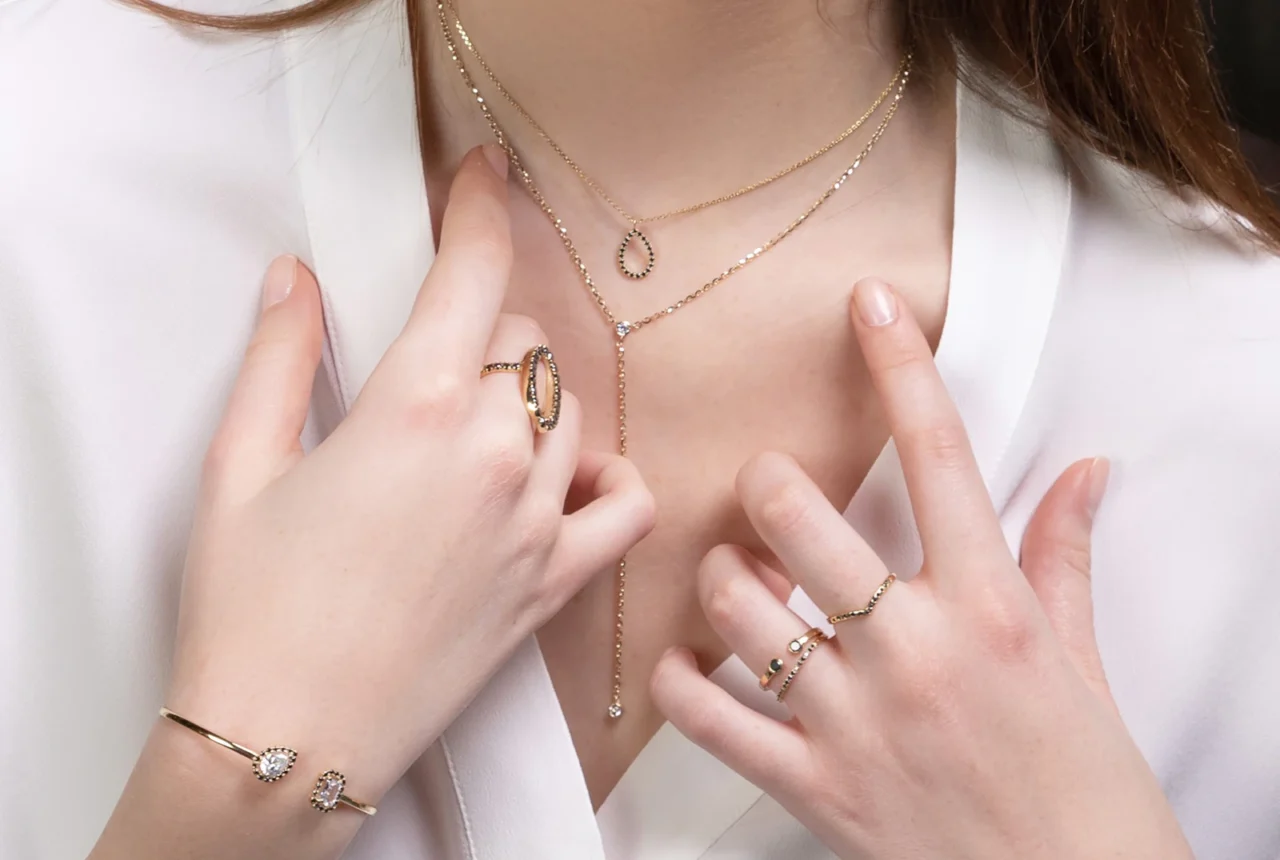
Walk into any jewelry store, or scroll through any online shop, and you will see the same golden necklace described four different ways: solid gold, gold filled, gold vermeil, or gold plated. They can look identical in photos. The prices, however, might range from $15 to $1,500. So what are you actually paying for?
The difference comes down to one thing: how much real gold is in the piece and how it got there. That single factor determines whether your jewelry lasts three months or three generations, whether it turns your finger green, and whether it survives a shower. After this guide, you will be able to read any product listing and know exactly what you are buying, and just as importantly, what it is honestly worth.
Want the deep dive on any one type? We cover whether gold filled jewelry tarnishes, whether you can shower in gold plated jewelry, and whether gold vermeil tarnishes in dedicated guides.
The Quick Answer: All Four Types Compared
If you only have a minute, this chart covers the essentials. Each type is explained in depth below.
| Solid Gold | Gold Filled | Gold Vermeil | Gold Plated | |
|---|---|---|---|---|
| How it is made | Gold alloy all the way through | Thick gold sheet heat-bonded to a brass core | Gold electroplated over sterling silver, min. 2.5 microns | Thin gold layer electroplated over base metal |
| Gold content | 41.7% to 99.9% depending on karat | At least 5% of total weight (US legal minimum) | Roughly 1% or less | Well under 0.5%, often 0.05% |
| Gold thickness | Entire piece | Typically 15 to 45+ microns equivalent | 2.5 microns minimum | 0.175 to 1 micron |
| Base metal | None | Usually brass | Sterling silver (925) | Brass, copper or steel |
| Tarnish | Does not tarnish | Highly resistant; lasts decades | Resistant, but plating wears over years | Tarnishes and wears within months |
| Waterproof for daily life | Yes | Mostly yes | No, remove before showering | No |
| Hypoallergenic | Generally yes (14k+) | Usually fine until worn through | Yes, silver base is skin-safe | Often not; base metals irritate |
| Typical lifespan | Lifetime, heirloom | 10 to 30 years | 2 to 10 years with care | 3 months to 2 years |
| Price for a necklace | $500+ | $50 – $150 | $50 – $200 | $10 – $50 |
| Resale value | Holds gold value | Minimal | Silver scrap value only | Essentially none |
What Is Solid Gold Jewelry?
Solid gold is exactly what it sounds like: the metal is a gold alloy through and through. Cut a solid gold ring in half and you will find the same material at the center as on the surface. This is why solid gold never flakes, never peels and never exposes a different metal underneath, no matter how many decades you wear it.
One common misconception is worth clearing up: solid gold jewelry is almost never pure gold. Pure 24 karat gold is so soft you could scratch it with a coin, so jewelers mix it with metals like silver, copper and zinc for strength. The karat number simply tells you the proportion of gold in the mix.
| Karat | Gold Content | Hallmark | Character |
|---|---|---|---|
| 24k | 99.9% | 999 | Deep yellow, very soft, rarely used for daily-wear jewelry |
| 18k | 75% | 750 | Rich color, luxury standard, excellent for sensitive skin |
| 14k | 58.3% | 585 | The everyday sweet spot: durable, warm color, better price |
| 10k | 41.7% | 417 | Hardest and cheapest; paler color, can dull slightly over time |
So is 18 karat gold real? Absolutely. It is 75 percent pure gold, which is why an 18k piece carries real melt value that a plated piece never will. And will 10k gold tarnish? True tarnish is rare, but because 10k contains more copper and silver than gold, it can develop a slightly duller surface over the years. A quick polish restores it.
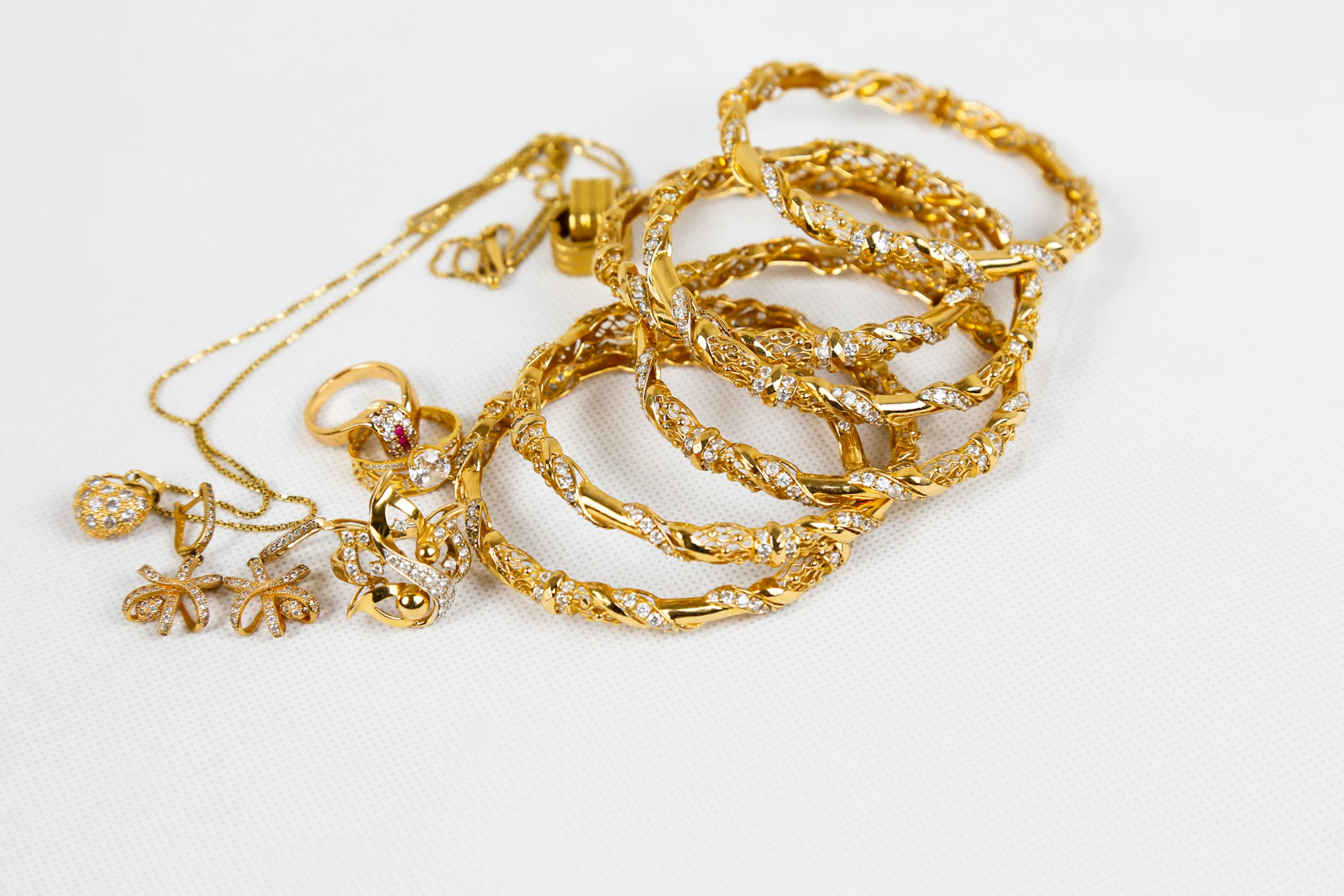
The honest verdict: solid gold is the only option that is a genuine long-term investment. It survives daily wear, water, sweat and time. The only real drawback is price, and for larger pieces like men’s gold chains, that price climbs quickly with weight.
What Is Gold Filled Jewelry?
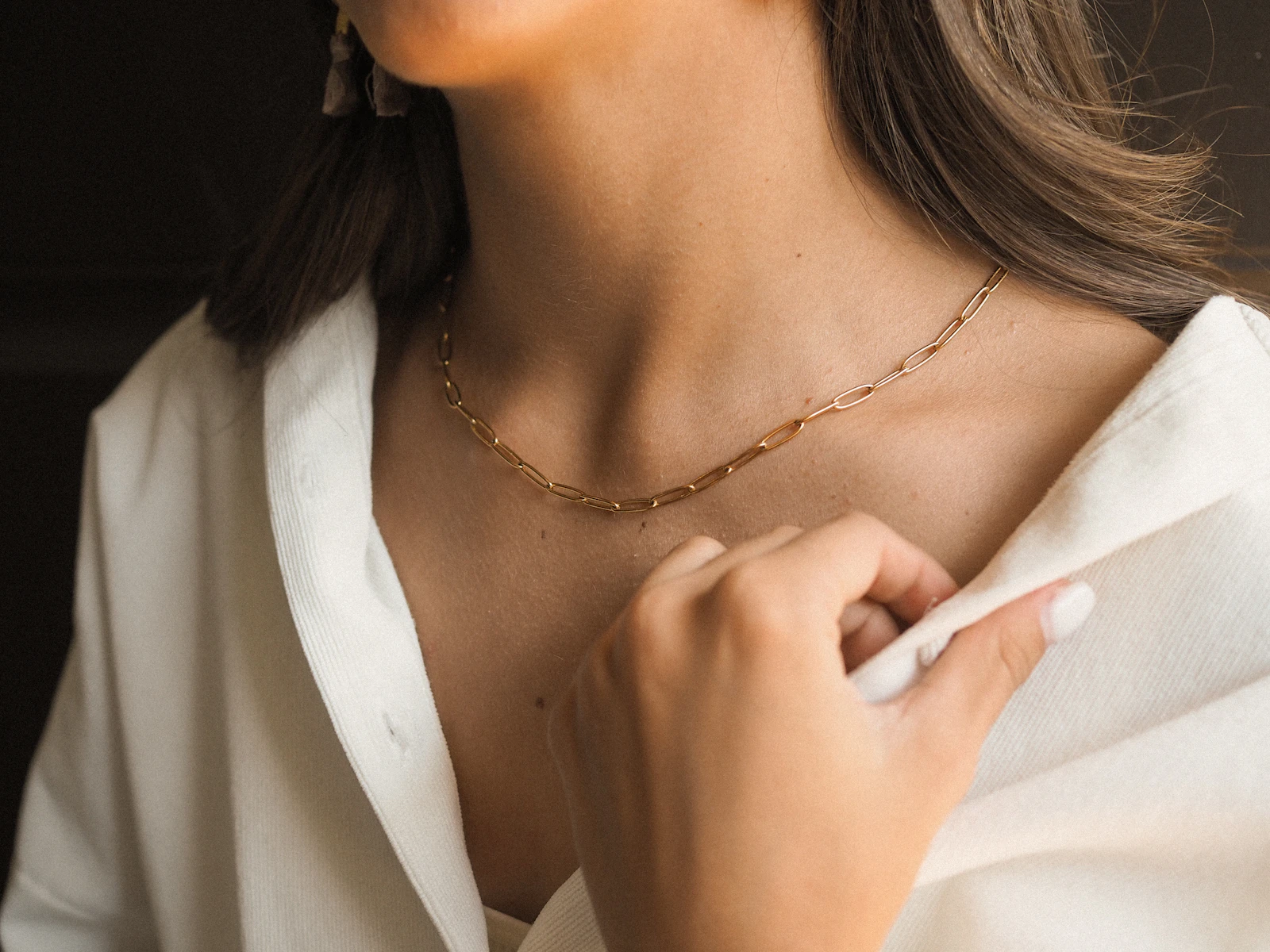
Gold filled is the most misunderstood term in jewelry, because the name suggests something filled with gold when the construction is actually the reverse: a thick sheet of real gold wrapped around a core of jeweler’s brass and bonded with heat and pressure. Think of it as a gold shell with a brass center, fused so firmly that the layers behave like a single metal.
What makes gold filled special is regulation. In the United States, a piece can only legally be sold as gold filled if the gold layer makes up at least 5 percent, one twentieth, of the item’s total weight. That is why you will see hallmarks like 14/20 GF or 1/20 14k GF stamped on quality pieces: it means one twentieth of the weight is 14 karat gold. If you have ever wondered what GF means on gold, that is it. The related term rolled gold refers to the same construction with a thinner layer, usually 1/40th of the weight.
Compare those numbers to plating and the difference is dramatic. The gold layer on a gold filled piece is often 20 to 100 times thicker than standard gold plating. That thickness is why gold filled jewelry routinely lasts 10 to 30 years of regular wear without exposing the brass beneath, and why many people wear 14k gold filled chains and hoops daily, through hand washing and workouts, with no visible change.
Is gold filled real gold? The surface you touch and see is genuinely 12k or 14k gold, not an imitation. The piece as a whole is not solid gold, which is reflected in the price. Does gold filled tarnish? Very rarely. Because the gold layer is thick and sealed, tarnish generally only appears if the piece is worn through after many years, or exposed to harsh chemicals like chlorine.
The honest verdict: gold filled is the best value in gold jewelry, full stop. It offers most of the durability of solid gold at roughly a tenth of the cost. Its limitations are cosmetic: it comes mostly in simple styles like chains, hoops and bangles, because the bonded sheet cannot be cast into intricate settings, and it cannot be resized or repaired with heat easily.
What Is Gold Plated Jewelry?
Gold plated jewelry starts life as a piece of brass, copper or steel, which is dipped in a chemical bath and coated with gold through electroplating. The result looks convincing on day one. The problem is arithmetic: standard plating is between 0.5 and 1 micron thick, and budget flash plating can be as thin as 0.175 microns. For perspective, a human hair is about 70 microns wide. You are wearing a layer of gold several hundred times thinner than a hair.
That explains the questions people ask most about this category. Does gold plated jewelry tarnish? Yes, inevitably. The thin layer wears away at friction points first, edges of rings, clasp areas, anywhere skin rubs, and once the base metal is exposed it oxidizes and darkens. Does gold plated jewelry turn your skin green? It can: when the copper in the base metal or alloy reacts with sweat, it leaves a harmless but annoying green-gray mark on the skin.
How long does gold plated jewelry last? With daily wear, expect the finish to visibly fade somewhere between three months and a year. Worn occasionally and kept dry, a well-made piece can look good for two years or more. Re-plating is possible, though it often costs more than the piece did.
One label deserves special attention: 18k gold plated does not mean the piece contains meaningful 18k gold. It means the microscopically thin coating was made from 18k gold. The karat of the plating affects the color tone, not the durability or the value. An 18k gold plated ring is still a base-metal ring.
The honest verdict: gold plated jewelry is fashion jewelry, and that is fine, as long as you buy it knowingly. It is the right choice for trying a bold trend, for pieces you will wear a handful of times, or for a $20 experiment. It is the wrong choice for anything you hope to wear daily or keep.
What Is Gold Vermeil Jewelry?
Gold vermeil, pronounced ver-MAY, is the upgraded, regulated cousin of gold plating. The gold vermeil meaning is precise, and in the US it is a legal standard with three requirements: the base must be sterling silver, the gold coating must be at least 2.5 microns thick, and the gold must be at least 10 karat. Most quality vermeil uses 14k or 18k gold over 925 sterling silver, which is why vermeil pieces are hallmarked 925.
Those three rules solve the two biggest problems of ordinary plating. First, the gold layer is at least two and a half times thicker than standard plating, so it wears far more slowly. Second, the metal underneath is sterling silver rather than brass or copper. Even when vermeil eventually wears at the edges after years, what shows through is silver, which will not irritate skin or leave green marks. This makes 18k gold vermeil one of the best options for sensitive skin outside of solid gold.
Does gold vermeil tarnish? The gold surface itself does not, but vermeil is not invincible. The plating gradually thins with friction, and if moisture reaches the silver beneath, the silver can tarnish and dull the piece’s appearance. Treat vermeil kindly, keep it dry, put it on after perfume and lotion, store it in a sealed pouch, and it commonly looks beautiful for five to ten years.
A note on terminology: sterling silver plated in gold is only vermeil if the coating meets the 2.5 micron minimum. Some sellers use vermeil loosely for thinly plated silver, so it is worth buying from brands that state their plating thickness outright.
The honest verdict: vermeil hits a sweet spot for demi-fine jewelry. Because sterling silver can be cast into detailed designs, vermeil offers gemstone settings, sculptural rings and intricate pendants that gold filled construction physically cannot, at prices far below solid gold.
Gold Filled vs Gold Plated: The Comparison Most People Actually Need
These two get confused constantly, and the gap between them is enormous. Gold filled carries at least 5 percent gold by weight, bonded as a thick sheet; gold plated carries a coating measured in fractions of a micron. In practice, that means a gold filled chain worn daily still looks like gold in year ten, while a gold plated chain worn daily often shows brass by month six. The price gap, perhaps $60 versus $20 for a similar necklace, is small compared to the lifespan gap. If you are choosing between gold filled or gold plated for anything you plan to wear regularly, gold filled wins every time.
Gold Vermeil vs Gold Plated
Vermeil is, structurally, premium plating with rules. Thicker gold, guaranteed karat, and a precious-metal base instead of mystery brass. Ordinary plated jewelry beats vermeil only on sticker price. If your budget allows the extra $20 to $40, vermeil buys you years instead of months, plus a hypoallergenic silver core. Between gold plated vs gold vermeil, plated only makes sense for one-season trend pieces.
Gold Vermeil vs Gold Filled
This is the genuinely close matchup, and the right answer depends on the piece. Gold filled has the far thicker gold layer, so for daily-wear basics that take friction, chains, bracelets, hoops, hoop huggies, it outlasts vermeil comfortably. Vermeil counters with design freedom and a sterling silver base: statement rings, stone settings and detailed pendants are usually only available in vermeil at this price level. A practical rule: gold filled for the pieces you never take off, vermeil for the pieces that make an entrance.
Gold Filled vs Solid Gold
Visually, almost no one can tell them apart, since the surface of both is real 14k gold. The differences are longevity and value. Solid gold lasts forever, can be resized, repaired and eventually resold at gold value. Gold filled lasts decades but not forever, cannot be resized without exposing the core, and has negligible resale value. For an engagement ring or an heirloom, solid gold is worth stretching for. For everyday layering pieces, gold filled delivers 90 percent of the experience for 10 percent of the money.
Which Type Should You Buy? Real-World Scenarios
- Everyday jewelry you never remove: solid gold if the budget allows, otherwise gold filled. Both handle water, sweat and sleep.
- Sensitive skin or metal allergies: solid 14k+ gold or gold vermeil. Both keep base metals like nickel and brass away from your skin.
- An engagement ring, wedding band or heirloom: solid gold only. It is the only type that can be resized, repaired and passed down.
- Statement pieces and gemstone settings on a budget: gold vermeil, which offers detailed designs plated jewelry can match in looks but not in lifespan.
- Gold chains for men: weight matters here, and a heavy solid gold chain is a serious expense. A 14k gold filled chain gives the same look and daily durability for a fraction of the price. Avoid plated chains, as constant friction against skin and clothing wears them fast.
- Trend pieces you may not love next year: gold plated, guilt-free.
How to Tell What You Already Own: Hallmark Decoder
Flip your jewelry over and look for tiny stamps, usually on the clasp tag, inner band or post:
| Stamp | What it means |
|---|---|
| 750, 18k | Solid 18 karat gold (75% gold) |
| 585, 14k | Solid 14 karat gold (58.3% gold) |
| 417, 10k | Solid 10 karat gold (41.7% gold) |
| 1/20 14k GF, 14/20 GF | Gold filled, 14k gold at 5% of weight |
| 1/40 RGP | Rolled gold plate, thinner cousin of gold filled |
| 925 (with gold color) | Gold vermeil or gold plated sterling silver |
| GP, GEP, HGE | Gold plated / gold electroplated over base metal |
| No stamp | Most likely plated costume jewelry |
Two more clues help. A magnet test rules out solid gold if the piece snaps firmly to a magnet, since gold, silver and brass are not magnetic, though a weak pull can come from steel clasps. And green or dark marks on your skin almost always point to worn plating over a copper-heavy base.
Care Tips: Making Every Type Last Longer
- Last on, first off. Perfume, lotion, sunscreen and hairspray all attack gold coatings. Let products absorb before your jewelry goes on.
- Keep plated and vermeil pieces dry. Remove them before showers, swimming and workouts. Chlorine and salt water are the fastest destroyers of thin gold layers.
- Wipe after wearing. A quick pass with a soft cloth removes the day’s oils and sweat before they sit on the metal overnight.
- Store airtight. Small zip bags or lined boxes slow oxidation dramatically, especially for vermeil, whose silver core tarnishes with air exposure.
- Clean gently. Lukewarm water, a drop of mild dish soap and a soft cloth are enough. Never use abrasive polish or ultrasonic cleaners on plated or vermeil jewelry; both can strip the gold layer.
- Solid gold and gold filled are more forgiving. They tolerate daily hand washing and the occasional swim, though the same habits above keep them brilliant.
Frequently Asked Questions
Is gold filled real gold?
Yes, the outer layer is genuine 12k or 14k gold, legally required to be at least 5 percent of the item’s weight in the US. The core is jeweler’s brass, so the piece is not solid gold, but everything touching your skin is real gold.
Does gold vermeil tarnish?
The gold surface does not tarnish, but the plating slowly thins with wear, and the sterling silver underneath can tarnish if exposed to moisture and air. With sensible care, vermeil typically keeps its color for five to ten years.
How long does gold plated jewelry last?
With daily wear, the finish usually begins fading within three months to a year. Worn occasionally and stored dry, it can stay presentable for around two years. Friction points like ring edges and clasps always fade first.
What does 925 mean on gold-colored jewelry?
925 is the purity mark for sterling silver, 92.5 percent silver. On a gold-colored piece, it tells you the item is sterling silver coated in gold, which is vermeil if the coating is at least 2.5 microns thick.
Is 18k gold plated real gold?
The plating itself is made from real 18k gold, but it is a microscopically thin coating over base metal. The piece has essentially no gold value, so treat 18k gold plated as fashion jewelry, not as an investment.
Can you shower with gold filled or gold vermeil jewelry?
Gold filled handles the occasional shower without trouble, though soap film can dull its shine over time. Vermeil should come off before showering: repeated moisture shortens the plating’s life and encourages the silver base to tarnish.
Is gold plated jewelry worth anything?
In resale terms, no. The gold layer is too thin to recover economically, so plated pieces carry no melt value. Its worth is purely in the wearing.
What gold jewelry doesn’t tarnish?
Solid gold of 14k and above effectively never tarnishes. Gold filled is the next best, resisting tarnish for decades. Vermeil resists well with care, while standard gold plated jewelry will always tarnish eventually.
Final Thoughts: Match the Metal to the Moment
There is no single best type of gold jewelry, only the right type for each purchase. Buy solid gold for the pieces that mark a chapter of your life, gold filled for the everyday staples you never take off, vermeil for statement designs and sensitive skin, and plated for low-stakes fun. The sellers counting on confusion between these terms are the only ones who lose when you know the difference.
Ready for the next step? Make sure any ring you order actually fits with our guide on how to measure ring size at home, browse luxury jewelry gifts under $500, or find a meaningful stone in our wedding anniversary gemstone guide.



10 Comments
Comments are closed.