Types of Earrings: A Visual Guide to 25 Styles
Most people own earrings in three or four styles and have no name for any of them. That becomes a problem the moment you try to shop: search for the wrong term and you get nothing like the pair you had in mind, and half of what you find has a name you have never seen before. Huggie? Threader? Ear jacket?
This guide names all of them. Below is every earring style you are likely to encounter, what makes each one different, and how to tell which will actually stay comfortable in your ear all day.
All Earring Styles at a Glance
| Style | What It Is | Best For |
|---|---|---|
| Stud | A single fixed piece sitting flat against the lobe | Daily wear, work, sleeping in |
| Hoop | A circle or oval passing through the lobe | Everyday style with more presence |
| Huggie | A very small, thick hoop that hugs the lobe closely | Second and third piercings, stacking |
| Drop | A short element hanging just below the lobe, mostly still | Office to evening transition |
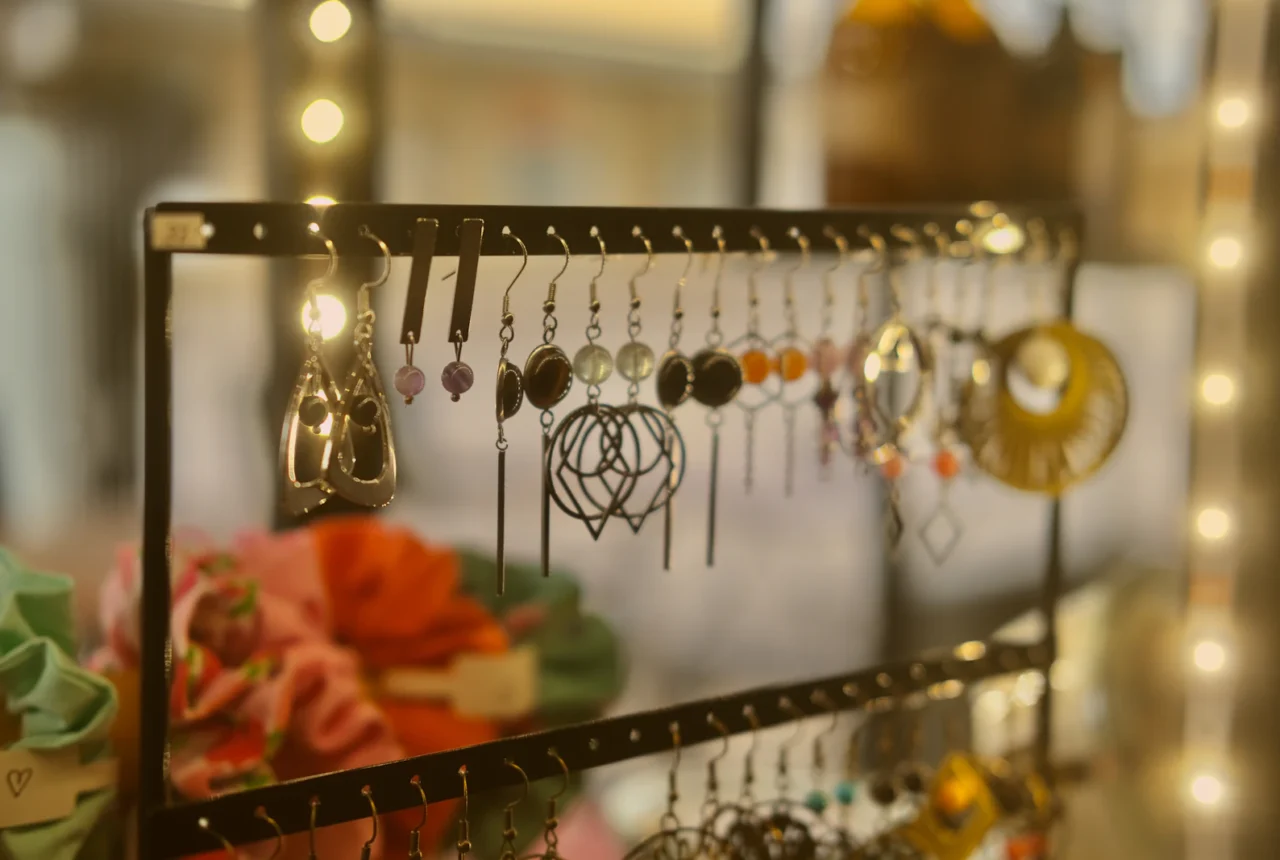
| Dangle | A longer hanging design that moves freely | Evening wear, adding movement |
| Chandelier | Tiered, branching drops that widen as they fall | Formal events, weddings |
| Ear cuff | Clips onto the outer cartilage, usually no piercing needed | Layered ear looks without extra piercings |
| Ear climber | Follows the curve of the lobe upward along the ear | A modern look with one piercing |
| Threader | A fine chain that threads through and hangs on both sides | Minimal, delicate styling |
| Ear jacket | A stud at the front with a separate piece behind the lobe | Two looks from one pair |
| Halo | A center stone ringed by smaller stones | Maximising sparkle on a budget |
| Cluster | Several stones grouped as one shape | Volume without a large center stone |
| Solitaire stud | One stone, usually diamond, in a simple setting | Classic gifts, anniversaries |
| Teardrop | A pear-shaped stone or shape hanging point-up | Softening angular features |
| Linear | A single straight vertical line of metal or stones | Elongating a round face |
| Shoulder duster | Extra long dangles reaching toward the shoulder | Statement evening looks |
| Tassel | Loose strands of chain or thread that sway | Summer and holiday styling |
| Hoop with charm | A hoop carrying a removable pendant | Changing the look without new earrings |
| Pearl stud | A single pearl, most often 6 to 8mm | Interviews, weddings, timeless wear |
| Barbell | A straight bar with a ball at each end | Cartilage and industrial piercings |
| Captive bead ring | A ring held closed by a tension-fitted bead | Helix, tragus and body piercings |
| Sleeper | A tiny plain hoop designed to be left in | Healing piercings, sleeping |
| Clip-on | Pinches the lobe, no piercing required | Unpierced ears, borrowing a look |
| Magnetic | Two magnets holding front and back together | Temporary wear, children |
| Statement | Oversized sculptural designs in resin, metal or acrylic | Making the earrings the outfit |

Studs, Hoops and Huggies: The Everyday Three
These three cover the majority of earrings actually worn day to day, and the distinctions between them matter when shopping.
Studs sit flush against the lobe on a short post, held by a back. Because nothing hangs, they cannot catch on clothing or hair, which is why they are the standard for work, exercise and sleeping. Size is measured in millimetres for plain studs, or in carats for stones.
Hoops range from 8mm sleepers to 70mm statement circles. The number quoted by sellers is the outer diameter, so a 30mm hoop is roughly the size of a large coin. Anything above about 40mm reads as a deliberate statement rather than a neutral daily earring.
Huggies are the in-between: a hoop small enough, usually 8 to 14mm, that it appears to grip the lobe with almost no gap. They are the most practical option for second and third piercings, because they sit tight enough not to tangle with the earring below.
Drop, Dangle and Chandelier: What Actually Separates Them
These three are used interchangeably in product listings, which causes most of the confusion. The real difference is length and movement.
A drop hangs a short distance below the lobe and stays relatively still. A dangle hangs longer and swings as you move. A chandelier is a dangle that branches outward into tiers, getting wider as it descends. In practice: if it barely moves, it is a drop; if it swings, it is a dangle; if it has multiple tiers, it is a chandelier.
Modern Styles Worth Knowing
Ear climbers, sometimes called crawlers or sweeps, enter through the lobe and then run upward along the ear’s edge. They create the illusion of several piercings from a single hole, which is why they became popular with people who want a curated ear without committing to more piercings.
Threaders are a fine chain with a thin post at one end. You thread it through the piercing and let as much chain hang as you like, front and back. They are the most adjustable earring style, and the most likely to be lost, since nothing locks them in place.
Ear jackets are two pieces: a stud that goes in from the front, and a decorative element that slides onto the post behind the lobe and peeks out below it. Most can be worn either as a plain stud or with the jacket attached, which is unusually good value.
Ear cuffs clip onto the outer cartilage with tension rather than a piercing. Quality varies enormously here: a cuff that is too loose falls off, and one that is too tight becomes painful within an hour. Look for an adjustable design you can gently squeeze to fit.
Earring Back Types
The back is what determines whether an earring stays in your ear. This is the part almost nobody considers before buying, and it is the most common reason for losing one.
| Back Type | How It Works | Security |
|---|---|---|
| Butterfly or push back | A friction clutch pushed onto a straight post | Low. Loosens over time and slips off |
| Screw back | Threads onto a grooved post | High. The standard for valuable studs |
| Locking or La Pousette | A clutch with an internal locking mechanism | Very high. Used for diamond studs |
| Lever back | A hinged wire that snaps closed behind the lobe | High. Best choice for drops and dangles |
| French hook or fish hook | An open curved wire, nothing securing it | Low. Add a rubber stopper |
| Latch back or hinged | A hinged post clicking into the hoop | High. Standard on hoops and huggies |
| Threader | Weight of the chain holds it in place | Low. Easy to lose |
| Clip-on and screw clip | Pressure against the lobe, no piercing | Moderate. Comfort depends on padding |
Two practical notes. First, butterfly backs wear out: the friction that holds them weakens with every insertion, so replace them every couple of years, or upgrade to locking backs for anything valuable. Second, if you have heavy earrings that tilt forward, oversized plastic or metal disc backs distribute the weight and hold the earring upright.
Which Earring Style Suits Your Face Shape
The principle is contrast: choose an earring shape that opposes your face shape rather than repeating it.
- Round face: long, vertical styles. Linear drops, teardrops and shoulder dusters add length. Avoid large round hoops and button studs, which echo the curve.
- Oval face: almost everything works. This is the shape stylists treat as the neutral baseline.
- Square or angular face: curved and rounded shapes. Hoops, circular drops and teardrops soften a strong jawline. Avoid geometric squares and hard angles.
- Heart-shaped face: styles that widen toward the bottom, like chandeliers and teardrops worn point-up, balance a narrower chin.
- Long or oblong face: short and wide. Studs, clusters and small to medium hoops add horizontal width. Avoid very long dangles.
- Diamond face: styles with visible width at the top, such as ear climbers and jackets, balance prominent cheekbones.
Treat this as a starting point rather than a rule. Hair length, glasses and neckline all affect the result more than face shape alone.
Materials and Sensitive Ears
If your ears itch, weep or crust after wearing earrings, the culprit is almost always nickel, which is present in most cheap alloys and in some white gold. It is the single most common contact allergy in the world.
The safest metals for pierced ears are implant-grade titanium, niobium, surgical stainless steel marked nickel-free, platinum, and solid gold at 14 karat or above. Sterling silver is usually tolerated well. Gold plated earrings are the riskiest category, because the plating wears through at exactly the point that sits inside the piercing, exposing the base metal underneath. Our guide to solid gold, gold filled, vermeil and gold plated jewelry explains how thin that layer really is, and why some jewelry turns your skin green covers the same reaction on skin.
Whether gold or silver flatters you more is a separate question, and one worth settling before you build a collection. Our guide to finding your skin undertone walks through three quick tests.
Frequently Asked Questions
What are the small hoop earrings called?
Huggies, if they sit tight against the lobe with almost no gap, usually 8 to 14mm. Slightly larger plain ones designed to be left in are called sleepers.
What is the difference between drop and dangle earrings?
Length and movement. Drops hang a short distance and stay fairly still; dangles hang longer and swing freely. The terms overlap and many sellers use them interchangeably.
Which earrings are best for everyday wear?
Studs and huggies. Neither catches on clothing or hair, both are comfortable to sleep in, and both suit any outfit. Choose screw or locking backs if you never take them out.
What earrings can I wear if I have no piercings?
Ear cuffs, clip-ons and magnetic earrings all work without a piercing. Ear cuffs are the most current-looking of the three and the most comfortable for long wear.
How do I stop my earrings from falling out?
Replace worn butterfly backs, which lose grip over time, and switch to screw backs or locking backs for anything valuable. For hook earrings, add clear rubber stoppers behind the lobe.
Why do my earlobes hurt with heavy earrings?
Weight pulling on the piercing. Use large disc-shaped backs to spread the load, limit wear to a few hours, and choose hollow or lightweight designs rather than solid metal for large statement pairs.