Ear Piercing Guide: Placement, Pain, Healing and Aftercare
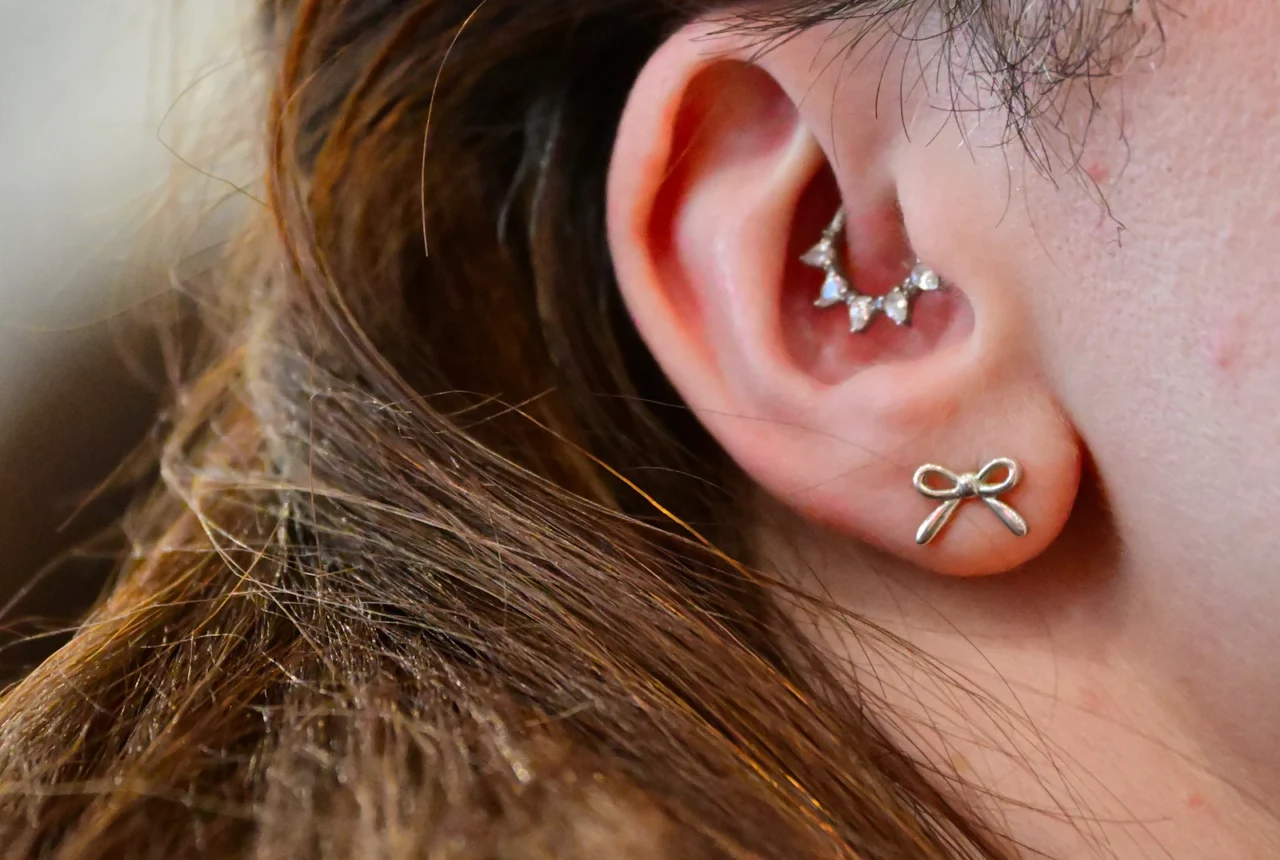
An ear piercing takes about four seconds and then occupies the next nine months of your life. That mismatch is the single most useful thing to understand before you book one, because almost every piercing that goes wrong goes wrong during healing rather than during the piercing itself.
This guide covers where each placement sits, how much it genuinely hurts, how long it takes to settle, and the aftercare that works. It is written for anyone building a curated ear as much as for someone getting their lobes done for the first time.
Every Placement, Compared
Ear piercings divide into two groups that behave completely differently. Lobe piercings pass through soft fatty tissue with a good blood supply and heal in weeks. Cartilage piercings pass through firm tissue with limited blood flow and heal in months, sometimes closer to a year.
| Piercing | Where it sits | Pain (1 to 10) | Healing time | Starter jewellery |
|---|---|---|---|---|
| Standard lobe | Soft lower lobe | 2 | 6 to 8 weeks | Flat-back stud |
| Upper lobe | Above the first hole, still soft tissue | 2 to 3 | 8 to 12 weeks | Flat-back stud |
| Helix | Outer upper cartilage rim | 4 to 5 | 6 to 12 months | Labret stud |
| Forward helix | Cartilage ridge nearest the face | 5 to 6 | 6 to 12 months | Labret stud |
| Flat | Flat cartilage panel below the upper rim | 5 | 6 to 12 months | Labret stud |
| Tragus | The small flap covering the ear canal | 4 to 6 | 6 to 12 months | Labret stud |
| Anti-tragus | Ridge opposite the tragus, above the lobe | 6 to 7 | 8 to 12 months | Small curved barbell |
| Daith | Innermost cartilage fold above the canal | 5 to 7 | 6 to 9 months | Clicker or small ring |
| Rook | Thick fold above the daith | 6 to 7 | 9 to 12 months | Curved barbell |
| Snug | Inner ridge parallel to the outer rim | 7 to 8 | 9 to 12 months | Curved barbell |
| Inner conch | Cupped centre of the ear | 5 to 6 | 6 to 12 months | Labret stud |
| Outer conch | Flat area between conch and rim | 5 to 6 | 6 to 12 months | Labret stud |
| Industrial | Two holes joined by one straight bar | 7 to 8 | 9 to 12 months | Straight barbell |
That last point deserves emphasis. Some placements depend entirely on having the right ridge or fold, and a good piercer will tell you honestly if your anatomy does not suit one. A piercer who agrees to every request regardless is not doing you a favour.

Healing Times at a Glance
The gap between lobe and cartilage healing is far larger than most people expect, and it is the main reason cartilage piercings develop problems. People treat a four-month-old helix as healed because it stopped hurting after three weeks.
| Standard lobe | 1.5 | |
| Upper lobe | 2.5 | |
| Daith | 7.5 | |
| Helix | 9 | |
| Tragus | 9 | |
| Conch | 9 | |
| Flat | 9 | |
| Rook | 10.5 | |
| Snug | 10.5 | |
| Industrial | 12 |
Needle or Gun
This is the one decision where the professional consensus is unambiguous. Get pierced with a single-use hollow needle, at a piercing studio, not with a spring-loaded gun at a jewellery counter.
A needle removes a tiny core of tissue, creating a clean channel that heals cleanly. A gun forces a blunt-ended stud through by impact, which tears surrounding tissue and, in cartilage, can shatter it. Guns also cannot be sterilised in an autoclave because they are largely plastic, so the parts that touch the ear are wiped rather than sterilised.
Gun studs make things worse in a second way: they are short, so as the ear swells the backing presses into the tissue, and the butterfly clasp behind traps discharge against the skin. Never allow a gun anywhere near cartilage. For lobes it is survivable, but a needle is still better and usually costs very little more.
Choosing a Studio
Look for four things. The studio should be a dedicated piercing studio rather than a retail counter. The piercer should open a sealed, single-use needle in front of you. Jewellery should be implant-grade and the studio should be able to tell you the exact material specification. And the piercer should be willing to say no to a placement your anatomy cannot support.
Membership of a professional body such as the Association of Professional Piercers is a good sign, though absence of it is not disqualifying in every country. What matters more is that the studio can answer material questions without hesitation.
Which Metals Are Safe
Starter jewellery is in your body during the most vulnerable period, so the material matters more at this stage than at any other point.
| Material | Safe for fresh piercings? | Nickel content | Notes |
|---|---|---|---|
| Implant-grade titanium (ASTM F136) | Yes, the standard choice | None | Light, strong, and available in anodised colours |
| Solid 14k or 18k gold | Yes, if nickel-free | Varies by alloy | Ask for nickel-free white gold specifically |
| Niobium | Yes | None | Excellent for sensitive skin, heavier than titanium |
| Surgical steel (316L) | Usually, but not ideal | Contains nickel | Fine for most people, a problem for anyone nickel-sensitive |
| Sterling silver | No | Usually none | Oxidises inside the wound and can stain the tissue permanently |
| Gold plated or vermeil | No | Depends on base metal | Plating wears through and exposes the base metal to the wound |
If plated jewellery has ever left a green mark on your skin, that is a signal to stay with titanium or solid gold. Our explainer on why jewellery turns skin green covers the chemistry, and our guide to solid gold versus plated and vermeil explains what the labels legally mean.

Aftercare That Actually Works
Modern aftercare is minimal, and most of the trouble people run into comes from doing too much rather than too little.
Do this. Spray or rinse with sterile saline twice a day, then pat dry with clean kitchen paper rather than a towel, which harbours bacteria and catches on jewellery. Sleep on the other side, or use a travel pillow with the piercing over the hole. Keep hair products, dry shampoo and perfume away from the site.
Do not do this. Do not twist or rotate the jewellery, which was standard advice thirty years ago and tears the healing channel. Do not use alcohol, hydrogen peroxide, tea tree oil or antibacterial soap, all of which kill the new cells you are trying to grow. Do not change the jewellery early. Do not swim in pools, lakes or the sea for the first two months.
Book the downsize. This is the step almost everyone misses. Piercers fit a longer bar initially to allow for swelling. Once the swelling subsides, usually four to eight weeks in, that extra length lets the jewellery move and snag, which is a leading cause of irritation bumps and migration. Go back and have a shorter post fitted.
Irritation or Infection
Most alarming-looking bumps are irritation, not infection, and the treatment is completely different. Irritation needs the cause removed, whereas infection needs a doctor.
| Sign | Irritation bump | Infection |
|---|---|---|
| Appearance | Small firm bump beside the hole, skin-coloured or pink | Spreading redness, swelling across the ear |
| Discharge | Clear or straw-coloured crust | Thick yellow or green pus |
| Pain | Tender when knocked | Throbbing, constant, worsening |
| Heat | None | Ear feels hot to the touch |
| Other | None | Fever, red streaks, swollen glands |
| What to do | Find the cause: pressure, snagging, a long bar, wrong metal | See a doctor promptly, and leave the jewellery in unless told otherwise |
Irritation bumps almost always have a mechanical cause: sleeping on it, a bar that is too long, headphones pressing on it, or hair being pulled through. Remove the cause and the bump usually resolves over several weeks.
Building a Curated Ear
The appeal of a curated ear is that it looks composed rather than accumulated. Three principles get you there.
Heal one thing at a time. Two cartilage piercings at once means two sites competing for the same limited blood supply, and you cannot sleep on either side. Space them three to six months apart.
Work outward from the lobes. Lobes heal fastest and give you the base of the arrangement. Add a helix, then a conch or flat, then the inner placements last.
Vary the scale. The same principle as any jewellery grouping: one larger focal piece, then progressively smaller studs climbing the ear. Our visual guide to 25 earring styles covers which shapes sit well at each height, and finding your skin undertone settles whether to build in gold or silver.

Once everything is healed, keep the jewellery clean. Residue builds up on posts and backs faster than people expect, especially with hair products. Our guide to cleaning jewellery at home covers the safe method for gold and titanium.
Frequently Asked Questions
How much does an ear piercing hurt?
A lobe is around a 2 out of 10, over in a second. Cartilage placements sit between 4 and 8, with the snug and industrial generally considered the sharpest. The sensation lasts a few seconds; the soreness lasts a few days.
How long does an ear piercing take to heal?
Lobes take 6 to 8 weeks. Cartilage takes 6 to 12 months depending on placement, even though it usually stops hurting within a few weeks. Do not change the jewellery based on how it feels.
Is a needle better than a piercing gun?
Yes, clearly. A needle removes a clean core of tissue; a gun forces a blunt stud through by force, tearing tissue and potentially fracturing cartilage. Guns also cannot be autoclaved. Never use a gun on cartilage.
What should I clean a new piercing with?
Sterile saline solution, twice a day, then pat dry. Avoid alcohol, hydrogen peroxide, tea tree oil and antibacterial soaps, which all damage the healing tissue.
Can I change my earrings after two weeks?
No. Changing jewellery before a piercing has healed reopens the channel and is one of the most common causes of long-term problems. Wait for the full healing window, and have the piercer make the first change.
Why do I have a bump next to my cartilage piercing?
Usually irritation rather than infection, caused by pressure, snagging or a bar left too long after the swelling went down. Remove the mechanical cause and it typically settles over a few weeks. Pus, heat and spreading redness point to infection and need a doctor.
What metal is best for a new piercing?
Implant-grade titanium to ASTM F136. It contains no nickel, is light, and is what reputable studios use as standard. Nickel-free solid gold and niobium are also safe. Sterling silver and plated metals are not.
How many piercings can I get at once?
Two lobes at once is fine. For cartilage, one at a time is the sensible limit, and ideally on alternating sides so you have a side to sleep on.
Do daith piercings help migraines?
There is no good clinical evidence that they do. Reported benefits are widely attributed to placebo effect. Get one because you like how it looks, not as a medical treatment.

1 Comment
Comments are closed.