Bracelets for Women: Every Style, Size and How to Stack Them
Bracelets are the hardest piece of jewellery to buy well. A necklace sits where you can see it in a mirror and a ring is sized precisely, but a bracelet has to survive typing, sleeves, car doors and handbag straps while still looking like it was chosen on purpose.
Which is why so many end up in a drawer. The style was right but the length was wrong, or the clasp was fiddly, or the metal turned dull after four months. This guide covers the twelve styles worth knowing, how to size one properly, and how to combine them without it looking accidental.
The 12 Main Bracelet Styles
Almost everything sold today is a variation on one of these. Knowing which family a piece belongs to tells you immediately how it will wear.
| Style | What it is | Best for | Everyday wear? |
|---|---|---|---|
| Chain | Interlocking metal links, flexible, clasped | Everything, the most versatile category | Yes |
| Tennis | A continuous line of matched stones, all the same size | Formal and everyday alike | Yes, with a safety catch |
| Bangle | Rigid circle, slides over the hand or opens on a hinge | Stacking in multiples, clean minimal looks | Yes, though it slides and knocks |
| Cuff | Rigid with an open gap, slips on from the side | A single bold statement, no clasp to fumble | Yes, easiest to put on alone |
| Charm | Chain base with attached pendants added over time | Sentimental gifting, building a piece over years | Yes, though it snags on knitwear |
| Beaded | Stones, glass or wood threaded on elastic or cord | Casual layering, colour, low budgets | Yes, elastic needs restringing every year or two |
| Link | Larger, visually distinct links such as curb, paperclip or Figaro | A modern, slightly masculine line | Yes, one of the most durable |
| Pearl | Strung pearls, knotted between each one | Occasions, classic dressing | No, pearls are soft and scratch easily |
| Bolo | Chain with a sliding bead so it adjusts to any wrist | Gifting when you do not know the size | Yes |
| Wrap | Long cord or chain that circles the wrist several times | Casual, textural, layered on its own | Yes |
| Cord and friendship | Woven thread, often with a metal or stone accent | Meaningful gifts, summer wear | Yes, but it will fade and fray |
| Watch-paired | Slim bangles or chains designed to sit beside a watch | Anyone who wears a watch daily | Yes |

Getting the Size Right
Bracelet sizing goes wrong more often than ring sizing, because there is no equivalent of a ring sizer that most people own. The method is simple: wrap a tape measure or a strip of paper around your wrist just below the wrist bone, snug against the skin but not compressing it. Mark it, measure it flat, then add the allowance for the style.
| 14 cm wrist | 16.5 cm / 6.5 in | |
| 15 cm wrist | 17.0 cm / 6.75 in | |
| 16 cm wrist | 17.8 cm / 7.0 in | |
| 17 cm wrist | 18.4 cm / 7.25 in | |
| 18 cm wrist | 19.0 cm / 7.5 in |
Two adjustments to that rule. Chunky link and charm bracelets need an extra half centimetre, because the thickness of the links eats into the circumference. Bangles are different again: they must clear the widest part of your hand, so measure around your closed hand with the thumb tucked in, not around the wrist.
If you are buying a gift and cannot measure, choose a bolo, a cuff or a bracelet with an extender chain. A 17.8 cm chain bracelet fits the majority of adult women, but a bolo fits everyone.
Which Metal to Choose
Metal decides how long the bracelet survives. Bracelets take more abrasion than any other piece of jewellery, so plating that would last five years on a pendant lasts eighteen months on a wrist.
| Metal | Typical lifespan on a wrist | Tarnishes? | Hypoallergenic | Relative cost |
|---|---|---|---|---|
| Solid gold, 14k or 18k | A lifetime | No | Yes | Highest |
| Platinum | A lifetime, develops a patina | No | Yes | Highest |
| Gold filled | 10 to 30 years | Rarely | Usually | Moderate |
| Sterling silver | A lifetime with polishing | Yes, readily | Usually | Low |
| Gold vermeil | 2 to 5 years | Base is silver, so eventually | Yes | Low to moderate |
| Gold plated brass | 6 months to 2 years | Yes, once worn through | No, brass contains nickel traces | Lowest |
| Stainless steel | Decades | No | Usually | Low |
If a bracelet is going to be worn constantly, gold filled is the best value in the middle of the market: it carries a bonded layer of real gold roughly a hundred times thicker than standard plating. Our guide to solid gold versus gold filled, plated and vermeil breaks down exactly what each term legally means.
If a bracelet has ever left a green mark on your wrist, that is copper in the alloy reacting with skin, not a sign of a fake. Our explainer on why jewellery turns skin green covers how to stop it.

How to Stack Bracelets Without It Looking Cluttered
Stacking is the difference between wearing bracelets and collecting them. Four principles cover almost every combination.
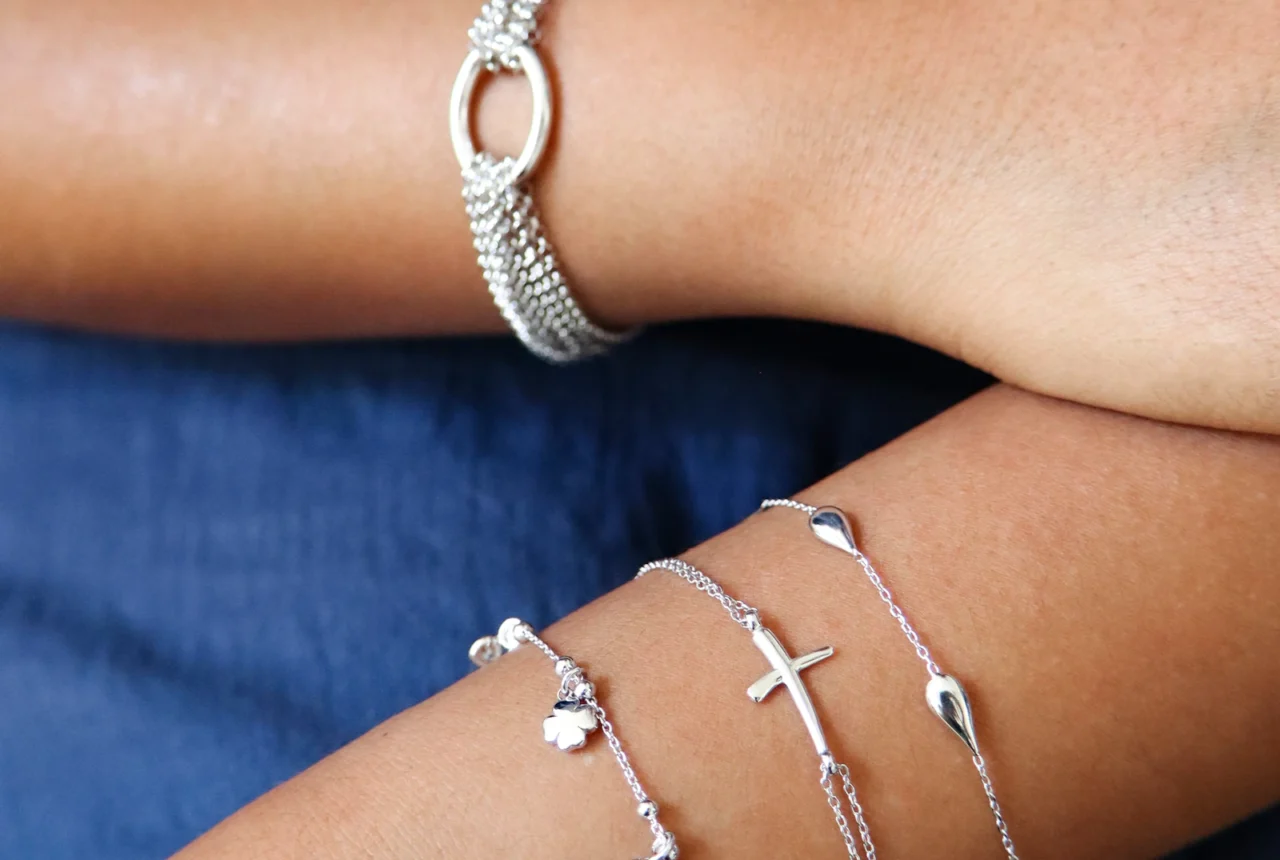
Vary the scale. Three bracelets of identical width read as one thick band. Pair one substantial piece with two fine ones and the eye has somewhere to rest.
Vary the texture, not just the metal. A smooth bangle, a faceted chain and a beaded strand look considered together. Three smooth chains look like you could not decide.
Keep an odd number. Three or five pieces sit better than two or four, for the same reason odd numbers work in flower arrangements. A watch counts as one.
Anchor with one hero piece. Every good stack has a single item that is the reason for it. A diamond tennis bracelet, a heavy signet-style cuff or an heirloom charm bracelet. The others are supporting cast and should be plainer than the hero.
Mixed metals are fine, and have been for a decade, but the mix should look deliberate. The simplest way is a two-to-one ratio: two gold pieces and one silver, or the reverse. If you are unsure which metal suits you as a base, identifying your skin undertone gives a reliable answer in about a minute.
Choosing by Occasion and Budget
| Occasion | Style that works | Sensible budget | Avoid |
|---|---|---|---|
| Office and daily | Fine chain, slim bangle, bezel-set tennis | $60 to $400 | Anything that jangles on a keyboard |
| Wedding or black tie | Tennis bracelet, pearl strand, delicate cuff | $300 to $5,000 | Charm bracelets, cord styles |
| Milestone gift | Solid gold link, tennis, engraved cuff | $400 to $3,000 | Plated pieces, they date the gift |
| Everyday summer | Beaded, wrap, gold filled chain | $30 to $150 | Sterling silver if you swim in it |
| Building over time | Charm bracelet or a bangle you add to | $150 upfront, then incremental | Discontinued or private-label systems |
Making Them Last
Bracelets fail in three predictable ways, and all three are preventable.
Clasps wear out. The spring in a lobster clasp and the tongue in a box clasp both lose tension after a few years. Have them checked annually and replaced when they feel loose, which costs far less than replacing the bracelet.
Elastic degrades. Beaded bracelets on stretch cord have a working life of one to two years. Restringing is cheap and prevents the scatter of beads across a car park.
Residue dulls them. Hand cream, soap and sanitiser collect under links and in stone settings. A soft toothbrush, warm water and washing-up liquid every couple of weeks keeps everything bright. Our guide to cleaning jewellery at home lists what is safe for pearls, plating and porous stones, which need different handling.
Take bracelets off before the gym and before swimming. Chlorine attacks the alloys in gold, and salt water accelerates tarnish on silver.

A Sensible First Three
If you are starting from nothing, three pieces cover almost every situation: a fine gold or gold filled chain for daily wear, one rigid piece such as a bangle or cuff for structure, and one piece with stones for occasions. Everything else is refinement.
Buy the daily chain in the best metal you can afford, because it will get the most wear per pound spent. Economise on the trend pieces, not the one you never take off.
Frequently Asked Questions
What size bracelet do most women wear?
17.8 cm, or 7 inches, is the standard adult size and fits most wrists between 15.5 and 16.5 cm. Petite wrists take 16.5 cm and larger wrists take 19 cm.
How tight should a bracelet be?
You should be able to fit one finger between the bracelet and your wrist. It should move a centimetre or so in each direction but not slide over the wrist bone onto your hand.
Can you wear gold and silver bracelets together?
Yes. Mixing metals looks intentional when one dominates, so aim for two pieces in one metal and one in the other rather than an even split.
Which wrist should you wear a bracelet on?
Whichever is more comfortable. Most people choose the non-dominant wrist, which takes fewer knocks. If you wear a watch, a bracelet can sit on the same wrist beside it or on the other one, both look fine.
How many bracelets should you wear at once?
One, three or five. Odd numbers sit better visually, and a watch counts as one piece in the count.
What is the most durable bracelet for everyday wear?
A solid gold or stainless steel link chain. Both resist abrasion, neither tarnishes, and link construction has no exposed prongs or beads to fail.
Why do my bracelets turn my wrist green?
Copper in the alloy reacting with moisture and skin acids. It is harmless and washes off, and it happens most with plated brass. Solid gold, platinum and stainless steel do not do it.
What bracelet is best as a gift when you do not know the size?
A bolo bracelet, which slides to any wrist, or a cuff, which flexes across a range of sizes. Both remove the risk entirely.

You Might Also Like