Diamond Tennis Bracelet: Carat, Cost and Fit Explained
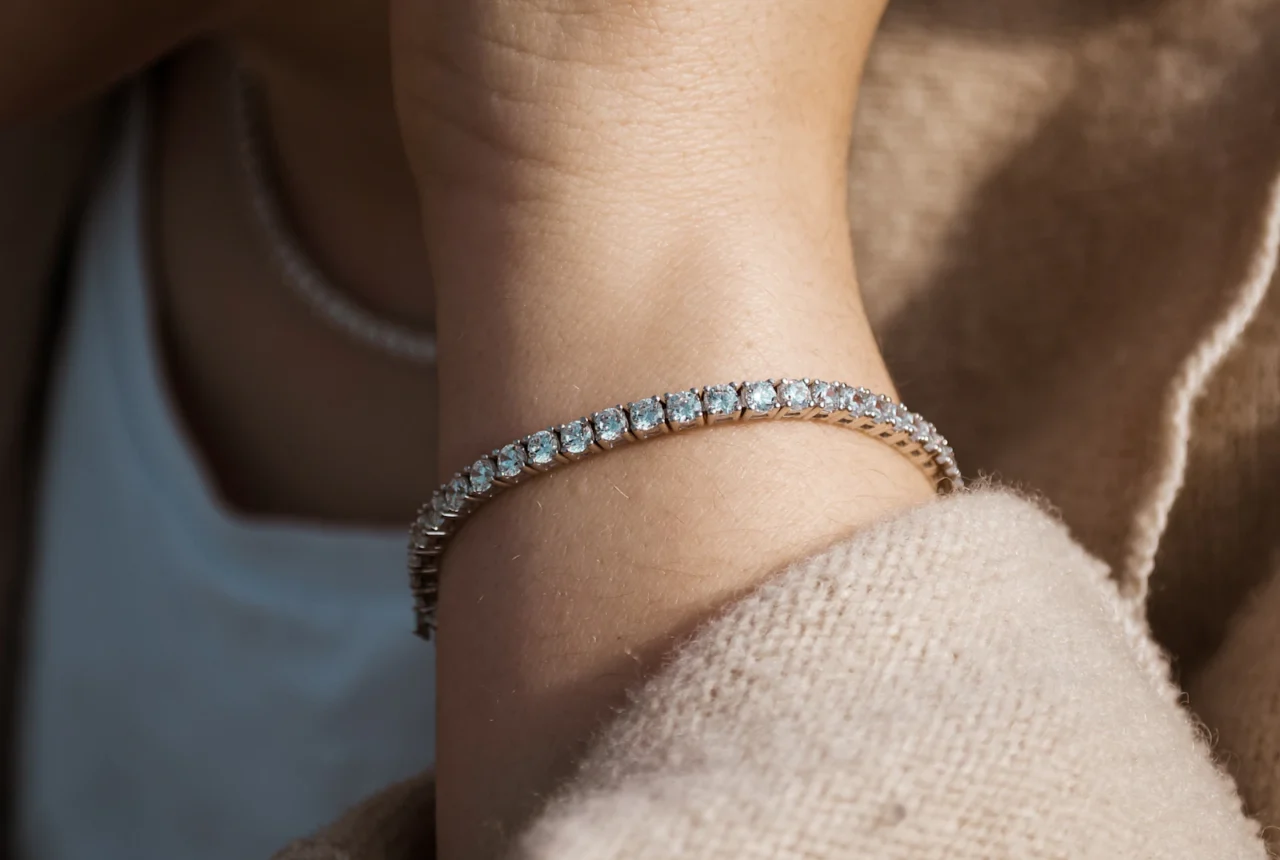
The diamond tennis bracelet got its name by accident. During a match at the 1978 US Open, Chris Evert’s diamond line bracelet came loose and scattered across the court. She asked officials to pause play while she found it, the moment was broadcast, and a piece of jewellery that had been sold for decades as a diamond line bracelet was renamed overnight by the people who watched it happen.
Nearly fifty years later it is still one of the few pieces that reads as formal and casual at the same time. It also happens to be one of the easiest pieces to overpay for, because almost none of the price is visible from a photograph. This guide covers what actually drives the cost, which construction survives daily wear, and how to buy one that fits.
What Makes a Bracelet a Tennis Bracelet
A tennis bracelet is a flexible line of diamonds of matched size and quality, set in a continuous row with no larger centre stone and no decorative breaks. Every link carries a stone, and each link hinges against the next so the bracelet drapes around the wrist rather than sitting rigid like a bangle.
That definition matters when you shop, because a lot of what is sold as a tennis bracelet is not one. If the stones step up in size towards the centre, it is a graduated line bracelet. If diamonds alternate with plain metal links, it is a station bracelet. Both are lovely, both cost less, and neither will look the same on the wrist.

The Four Setting Styles, and Which One Lasts
Setting style is the single biggest difference between a bracelet you wear for thirty years and one that goes back to the jeweller every eighteen months. It affects sparkle, security and how much metal you can see from the side.
| Setting | How it looks | Sparkle | Security | Best for |
|---|---|---|---|---|
| Four-prong | Classic, stone sits high and open | Highest, light enters from all sides | Good if prongs are checked yearly | Evening wear, maximum brilliance |
| Shared prong | Stones sit close, less metal visible | Very high, looks like a continuous line of light | Moderate, one loose prong affects two stones | Getting the most visual weight per carat |
| Channel | Stones sunk between two metal walls | Lower, sides are covered | Excellent, nothing to snag | Daily wear, knitwear, hands-on work |
| Bezel | Thin metal rim around each stone | Lowest of the four | Highest of the four | Sport, travel, anyone who has lost a stone before |
If you plan to wear the bracelet more or less permanently, which is what most people end up doing, a shared-prong setting with a properly engineered underrail is the best compromise. If you have already lost a stone from something, go bezel and stop worrying.
How Much Carat Weight Do You Actually Need
Tennis bracelets are priced by total carat weight, written as TCW or ctw. That figure is the sum of every stone, typically spread across 40 to 60 of them. It tells you almost nothing about how the bracelet looks until you convert it into the diameter of a single stone.
| Total carat weight | Approx. size per stone | How it reads on the wrist | Typical natural diamond price | Typical lab-grown price |
|---|---|---|---|---|
| 1.0 ct | 1.7 mm | A fine glitter line, subtle from a metre away | $900 to $2,000 | $300 to $700 |
| 2.0 ct | 2.1 mm | Clearly visible, still delicate | $2,200 to $4,500 | $600 to $1,400 |
| 3.0 ct | 2.5 mm | The classic proportion, reads as jewellery not accent | $3,800 to $8,000 | $900 to $2,200 |
| 5.0 ct | 3.0 mm | Substantial, noticed across a room | $8,000 to $18,000 | $1,800 to $4,500 |
| 7.0 ct | 3.3 mm | Statement piece, heavy on the wrist | $15,000 to $32,000 | $3,000 to $7,500 |
| 10.0 ct | 3.8 mm | Formal, unmistakably a major piece | $28,000 to $65,000 | $5,500 to $13,000 |
Notice how little the individual stone grows. Going from 3 ct to 10 ct total, more than triple the weight and roughly seven times the price, moves each stone from 2.5 mm to 3.8 mm. The line gets thicker and heavier, but nobody counting from across a table sees a sevenfold difference.
| 1.0 ct total | 1.7 mm | |
| 2.0 ct total | 2.1 mm | |
| 3.0 ct total | 2.5 mm | |
| 5.0 ct total | 3.0 mm | |
| 7.0 ct total | 3.3 mm | |
| 10.0 ct total | 3.8 mm |
The practical takeaway: 2 ct to 3 ct total is where most people land, and it is the range where the money buys the most visible change. Above 5 ct you are buying presence and weight, which is a legitimate thing to buy, but it is not the same as buying sparkle.
What Specifications Are Worth Paying For
Melee diamonds, the small stones used in tennis bracelets, follow different rules to a solitaire. Nobody puts a loupe to a 2 mm stone, and the grading margins that cost a fortune in an engagement ring are invisible here.
| Factor | Buy this | Do not pay for | Why |
|---|---|---|---|
| Colour | G to I | D to F | Tint is undetectable at this size, especially in yellow gold |
| Clarity | SI1 to SI2 | VVS or flawless | Inclusions in a 2 mm stone are invisible without magnification |
| Cut | Very good to excellent | Nothing, this is the one to spend on | Cut is the only thing that makes small stones sparkle |
| Matching | Consistent colour across all stones | Certification for each stone | One yellower stone in a line of white ones is the flaw people notice |
| Metal | 14k gold or platinum | Gold plated or vermeil | Plated settings wear through at the clasp and prongs within a couple of years |
Two things do deserve scrutiny. First, ask whether the stones are matched for colour, because a mismatched line looks cheap in a way that no grading certificate captures. Second, check the metal is solid rather than plated. Our guide to solid gold versus gold filled, plated and vermeil explains why the distinction matters most on pieces that flex constantly.

Getting the Fit Right
A tennis bracelet should move about a centimetre in either direction on your wrist and no more. Too loose and it spins so the clasp ends up on top, which looks wrong and puts stress on the wrong link. Too tight and it digs in when you rest your wrist on a desk.
Measure your wrist with a tape measure just below the wrist bone, snug but not compressed, then add the allowance below.
| Wrist measurement | Bracelet length | Fit |
|---|---|---|
| 13.5 to 14.5 cm (5.3 to 5.7 in) | 16.5 cm / 6.5 in | Petite |
| 14.5 to 15.5 cm (5.7 to 6.1 in) | 17.0 cm / 6.75 in | Small |
| 15.5 to 16.5 cm (6.1 to 6.5 in) | 17.8 cm / 7.0 in | Standard, fits most adults |
| 16.5 to 17.5 cm (6.5 to 6.9 in) | 18.4 cm / 7.25 in | Medium-large |
| 17.5 to 19.0 cm (6.9 to 7.5 in) | 19.0 cm / 7.5 in | Large |
Most tennis bracelets are made from removable links, so a jeweller can shorten one in about twenty minutes. Lengthening is harder and sometimes impossible, because it means sourcing extra stones that match the originals. If you are between sizes, buy the longer one.
The Clasp Is the Weak Point
Every tennis bracelet that has ever been lost was lost at the clasp. A box clasp with a single tongue is the industry standard and it works, right up until the moment the tongue loses tension after a few years of opening and closing.
Insist on a safety mechanism, either a figure-of-eight latch that folds over the closed clasp, or a double-tab pressure release. A bracelet with a safety catch and a well-made box clasp is genuinely secure. One without is a bet you will win most days.
Get the clasp and prongs checked once a year, at the same appointment where you have your rings checked. It costs nothing at most jewellers and it is the difference between a repair and a claim.
Natural or Lab-Grown
Tennis bracelets are the strongest possible argument for lab-grown diamonds, more so than any other category. The stones are small, chemically and optically identical, and no one is examining a 2 mm melee stone for provenance. The price gap is between 60 and 80 percent, which means a lab-grown 5 ct bracelet costs roughly what a natural 2 ct one does.
What you give up is resale value, which for a tennis bracelet is a smaller sacrifice than it sounds. Second-hand natural diamond jewellery typically returns a fraction of retail anyway, so the theoretical advantage rarely converts into real money.
The honest version: if the bracelet is a gift with meaning attached to the material, buy natural. If you want the most visible diamond for the budget, buy lab-grown and go up two or three carats.

Wearing and Caring for It
Tennis bracelets get dirty faster than any other piece of fine jewellery because they sit against the inside of the wrist, collect hand cream and soap, and have dozens of small cavities under the stones where residue sits. A film under the settings kills the sparkle far more effectively than any flaw in the stones.
Warm water, a drop of washing-up liquid and a soft toothbrush once a fortnight will keep it bright. Our full guide to cleaning jewellery at home covers what is safe and what is not.
Take it off for the gym, for swimming and for sleeping. Chlorine attacks the alloys in gold over time, weights knock stones, and a night of turning over will bend prongs on a bracelet faster than a year of ordinary wear.
On styling, a tennis bracelet stacks beautifully with a slim watch or a plain gold bangle, but it should be the shiniest thing on that wrist. If you are building a stack, our guide to bracelets for women covers which styles sit well together. And if you are choosing between white and yellow metal, finding your skin undertone settles it faster than trying things on under shop lighting.
Frequently Asked Questions
How much should a diamond tennis bracelet cost?
A 3 ct natural diamond bracelet in 14k gold typically retails between $3,800 and $8,000, and the lab-grown equivalent between $900 and $2,200. Below roughly $500 for a natural stone bracelet, expect either very low carat weight or plated metal.
What carat weight is best for a tennis bracelet?
Between 2 ct and 3 ct total for most people. That range is clearly visible without being heavy, and it is where each extra carat buys the biggest visual difference. Above 5 ct you are buying presence rather than sparkle.
Can you wear a tennis bracelet every day?
Yes, if the stones are in channel or bezel settings and the clasp has a safety catch. Prong settings survive daily wear too, but need a professional check once a year to catch a loose prong before a stone drops.
How do I know if my tennis bracelet fits?
You should be able to slide one finger between the bracelet and your wrist, and it should move around a centimetre in each direction without the clasp rotating to the top of your wrist.
Are lab-grown diamonds worth it in a tennis bracelet?
For most buyers, yes. The stones are too small for anyone to distinguish, and the 60 to 80 percent saving means you can wear three times the carat weight for the same money.
Why do tennis bracelets fall off?
Almost always because of clasp failure rather than a broken link. The tongue in a box clasp loses tension over years of use. A folding safety latch over the clasp prevents nearly all losses.
What is the difference between a tennis bracelet and a line bracelet?
Very little. A tennis bracelet is a line bracelet, specifically one where every stone is the same size. Graduated line bracelets, where stones grow towards the centre, are technically a different style.
Should a tennis bracelet be worn on the left or right wrist?
There is no rule. Most people wear it on the non-dominant wrist, which takes fewer knocks and keeps it away from a watch if they wear one.